
The Livonian War: A History Guide for Baltic Visitors
Understand the Livonian War of 1558-1583, the end of medieval Livonia and the different histories behind Turaida, Narva and northern Estonia.
Last updated November 2026
Contents7
The Livonian War of 1558-1583 ended the political order of medieval Livonia. Russia invaded a region covering much of present-day Estonia and Latvia. Lithuania, Poland, Sweden and Denmark became involved as control of Baltic lands and ports changed. For visitors, the key is to distinguish that struggle from the earlier Baltic Crusades and the later Great Northern War.
Where was Livonia?
Medieval Livonia was not an early name for all three modern Baltic states. It was a group of territories in what are now Estonia and Latvia, with several rulers rather than one strong central government. Bishops, the archbishop of Riga, the Livonian branch of the Teutonic Order and towns had different interests.
Latvia's National Encyclopaedia account of Livonia explains that divided structure and its collapse. Lithuania developed separately to the south. It became a major participant in the war, rather than simply another province of Livonia.
That distinction helps when reading a castle label. A bishop's castle and an order's castle could belong to rival centres of power. Similar walls do not establish that their owners acted together. Our Baltic Crusades guide explains how those medieval institutions arose, centuries before this war.
Why did the war begin?
Russia sought access to Baltic ports and trade. Livonia's weak political structure made it vulnerable, while its neighbours also had interests in the region. The Lithuanian national encyclopaedia's war history identifies both those wider aims and the immediate disputes over tribute and Livonia's ties with Lithuania.
Ivan IV's forces invaded in 1558 and captured Narva and Tartu that year. The conflict expanded as Livonian rulers sought outside help. It was not one unchanging alliance fighting Russia for the entire period: rival states pursued their own interests, and political arrangements shifted.
A timeline of the main changes
| Date | Development | What to keep separate |
|---|---|---|
| 1558 | Russian forces invade Livonia and take Narva and Tartu | The start of the war, not the date every castle changed hands |
| 1561-1562 | Northern Estonia submits to Sweden in 1561; agreements reshape the remaining Livonian territories, with the Courland settlement implemented in 1562 | Medieval Livonia breaks apart before the war ends |
| 1581 | Swedish forces capture Narva | Narva's change of ruler is one part of the wider conflict |
| 1582 | Russia and the Polish-Lithuanian Commonwealth agree the truce of Yam-Zapolsky | One settlement, involving different parties from the next |
| 1583 | Russia and Sweden agree the truce of Plussa | The conventional end of the war |
Scroll for more →
The Lithuanian encyclopaedia supplies the opening and closing chronology; the Latvian State Historical Archives exhibition explains the 1561 settlement. Narva Museum documents the city's separate changes of ruler.
What changed in 1561?
The archives' account dates the legal founding of the Duchy of Courland and Semigallia to 28 November 1561. The agreement was implemented at Riga Castle on 5 March 1562, when the order was secularised and its last master, Gotthard Kettler, became a secular duke. Northern Estonia had turned to Sweden, while other Livonian territories submitted to Sigismund II Augustus, king of Poland and grand duke of Lithuania.
These were different political arrangements, not the creation of modern Estonia and Latvia. Nor should the Polish-Lithuanian Commonwealth be projected unchanged onto the opening of the war: the Union of Lublin came in 1569.
For a trip, use a map dated to the period being discussed. A modern border map is useful for transport, but it cannot explain the loyalties shown in a sixteenth-century exhibition.
How Turaida fits the story
Turaida was a castle of the archbishop of Riga. It should not automatically be described as a castle of the Livonian Order. The Turaida Museum Reserve's castle history traces changes to the site and its administration, including its connection with Elert Kruse during the war.
The museum also explains the castle's buildings and exhibitions. Its estate history records Polish audits in 1582 and 1590. These records give another view of political change: castles needed land, revenue and people working beyond their walls.
Read the war as background to a Turaida visit, rather than treating every surviving room as an unchanged scene from 1558. The reserve includes buildings from different periods, and parts of the castle have been restored. Choose exhibitions that match your interests, then check the museum's current access information before travelling from Riga.
Narva and northern Estonia
Narva Museum's own history describes the Russian capture in 1558 and the Swedish conquest in 1581. Those dates make the city a useful second case study alongside Turaida. Two places in medieval Livonia could experience the same war through different rulers and local events.
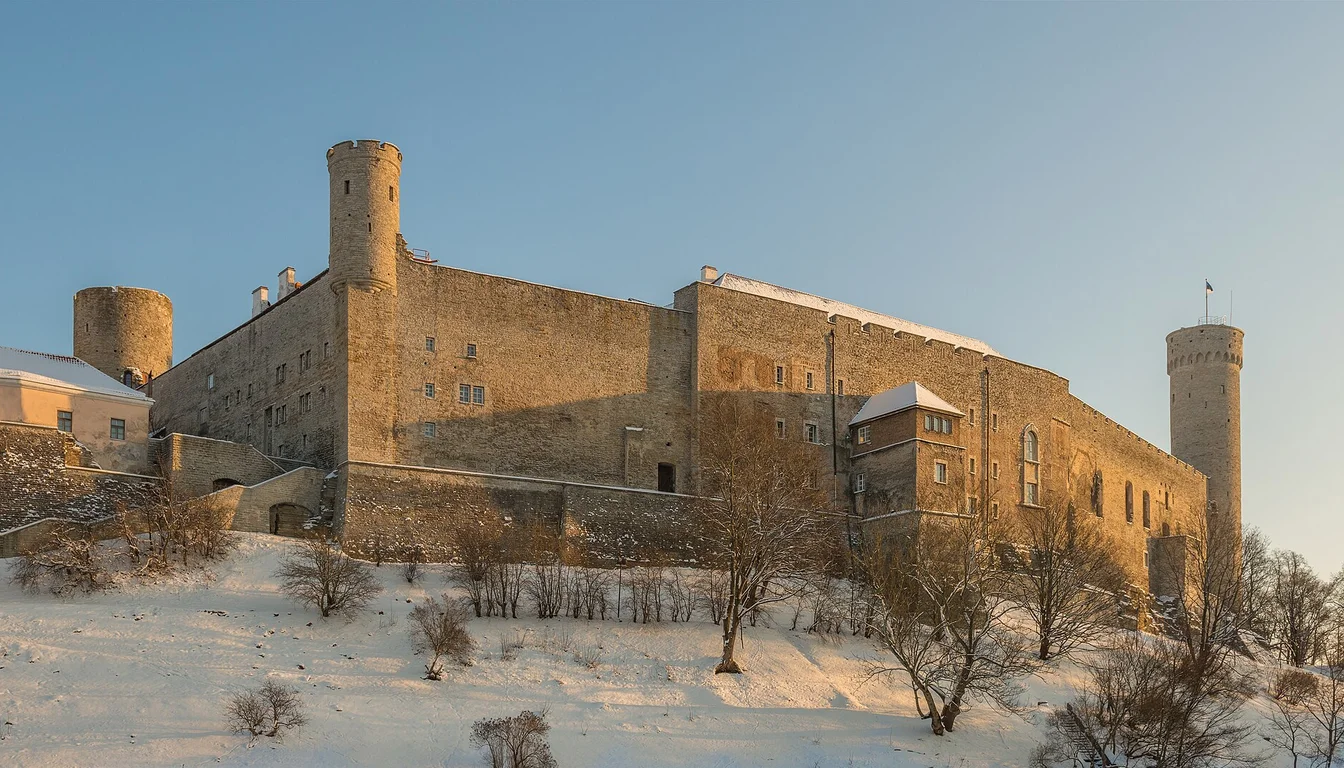
In Tallinn, Toompea Castle introduces another layered political history. Do not assume that the buildings visible today all date from the Livonian War. A present-day parliament, later additions and older fortifications need to be read separately.
For a first visit, choose one castle and read its museum account before adding another. Compare who controlled it, when that changed and what evidence survives. Our Baltic itinerary guide helps place those visits within a trip; the history overview follows the much later independence and occupation periods.
Photograph credit
The photograph shows Toompea in Tallinn, not Turaida. Toompea loss 2014.jpg by Abrget47j, CC BY-SA 3.0. Cropped and resized.
