
Estonia visitor guide
Plan Estonia’s capital, arts, food, islands and nature, with official resources for Prangli ferries, fishing and practical city services.
Last updated October 2026
Contents13
- Vitals: country, language and travel choices
- Languages for a visit
- Tallinn sights and Alexander Nevsky Cathedral
- Arts, museums and performances
- Food and local shopping
- Public evenings in Tallinn
- Prangli: a day trip needs a return plan
- Lahemaa, nature and fishing
- Regions beyond the capital
- Folklore and common confusions
- Arvo Pärt and cultural lives
- Visitor maps and useful services
- Photograph credit
Estonia can be a Tallinn city break, an island trip or a slower route through forests and coastal towns. Those choices need different transport and weather allowances. Begin with the country map, decide whether the capital or a region is the main purpose, and avoid turning a distant day trip into an afterthought.
Vitals: country, language and travel choices
Tallinn is Estonia's capital, Estonian is the state language, and the currency is the euro. The EU country profile supplies the official country context. Statistics Estonia provides dated population figures and definitions. A population statement needs a reference year; a travel guide's round number should not be read as a census result.
Languages for a visit
Estonian is a Finnic language, distinct from Latvian and Lithuanian. Learn a greeting and ask politely which language a person prefers. A museum may offer English interpretation even when a small local service does not. Russian-language ability and ethnicity are different measures, so neither should be inferred from the other. Use the language information on a particular venue's site rather than assuming one language works everywhere.
Tallinn sights and Alexander Nevsky Cathedral
Visit Tallinn supplies a city map and attraction information. Divide the historic centre and a museum visit into manageable parts. Slopes, cobbles and tower stairs can change how long a short-looking route takes. A city map is a starting point, not a promise of step-free access.
Alexander Nevsky Cathedral's official visitor profile dates the cathedral to 1900, when Estonia was within the Russian Empire. Its religious and imperial setting is part of the documented history. Stories connecting Toompea with the legendary Kalev belong to folklore; they do not by themselves prove a particular motive for the cathedral's construction. Follow the cathedral's arrangements for worship and visiting rather than treating it as an unrestricted museum.
Arts, museums and performances
The Art Museum of Estonia operates Kumu, Kadriorg Art Museum and other sites. Each has its own exhibitions, address and visiting arrangements. Kumu and Kadriorg are distinct museums, so check which collection or temporary exhibition you want before buying a ticket.
For gallery visits, read the current exhibition information from Haus Gallery and Allee Gallery. Check the exhibition dates and location before travelling for a particular artist. For opera and ballet, the Estonian National Opera publishes productions and bookings. Confirm the performance language, subtitles where offered, venue and access on the chosen event page.
Food and local shopping
Estonian food draws on rye bread, fish, potatoes and seasonal ingredients, alongside contemporary restaurants. Visit Estonia's food information helps choose a region or style. Read a venue's menu for actual ingredients and ask directly about allergies. A market lunch and a long restaurant meal fit a day differently; leave enough time when combining either with a performance.
For a concrete food-and-art area, Visit Tallinn's Telliskivi guide connects creative businesses with the nearby Balti Jaama Market. Fotografiska Tallinn's restaurant publishes its current menu and reservations, while its café and bakery offer a different kind of stop. An exhibition ticket and a restaurant booking are separate decisions. Check both if you want to combine photography with a meal.
For craft shopping, ask about the material, maker and place of production. Eesti Pank's museum and shop offers a way to explore Estonian money and collector products. Ask the shop about access and current stock before travelling for a specific coin.
Public evenings in Tallinn
Choose an evening from a venue's current programme of live music, bar events or club nights. Check the event date, age rules and admission terms. A standing concert and a seated bar suit different plans, so confirm the format before booking. Allow time for the journey back to your accommodation.
Tallinn's municipal transport information helps plan the route home. Confirm the last service for your stop. If using a taxi or ride booking, check the vehicle identity and fare basis through the operator. A central room can reduce travel after a performance, but consider whether the street outside is active late at night.
Prangli: a day trip needs a return plan
Visit Tallinn's nearby-island ferry guide identifies the Prangli route from Leppneeme harbour in Viimsi to Kelnase on Prangli. Leppneeme is not Tallinn's main passenger harbour. Allow separate travel from the city to the departure point and back.
Consult the ferry operator for the current timetable, booking, weather updates and return sailing. Choose the return before setting out and check for any service changes that day. Island roads and paths differ from a paved city walk, so check conditions and arrange local transport if you need it.
Lahemaa, nature and fishing
The Estonian Environmental Board and RMK's nature-visit information supply protected-area and trail guidance. Lahemaa can include coastal villages, forests and bog landscapes, but choose a specific trail and access point. Wet ground, seasonal restrictions and limited daylight can change what is sensible on a given day.
Before fishing, read the Environmental Board's current recreational-fishing requirements and use the permit service it identifies. Check the rules for your chosen water, species, method and season, including local restrictions and catch limits. Obtain any required permit before setting out.
Regions beyond the capital
The national tourism board distinguishes the islands, northern coast, southern Estonia and university-city visits. Choose a region because you have time for its transport and landscape, rather than counting it as a brief extra after Tallinn. A ferry-dependent island day and a rail-connected city visit carry different risks of delay. Build that distinction into accommodation nights and onward bookings.
Folklore and common confusions
The Estonian Literary Museum studies folklore, literature and cultural history. Its collections give stories and quotations a source and setting. Read a legend as a cultural work and distinguish its characters from documented people. Museum collections and institutional biographies help trace an author's life and work without treating a quotation as a description of every Estonian.
Arvo Pärt and cultural lives
Composer Arvo Pärt gives a music-focused trip another option beyond Tallinn's main museums. The Arvo Pärt Centre preserves his archive and publishes visitor and event information. The Lääne-Harju municipality's 2026 visitor catalogue locates the centre in Laulasmaa. Check the centre's current programme and travel arrangements rather than assuming that a concert or guided visit takes place every day.
Use the centre's biography and collections to explore Pärt's work, then choose an exhibition or event from its published programme. A music visit needs both time at the centre and a plan for the journey from Tallinn.
Visitor maps and useful services
Use Visit Tallinn's current map and visitor-information service for sightseeing. For emergencies, Estonia uses 112. For a routine pharmacy visit, locate a current licensed branch and ask about its opening hours. Barbers and other personal services need their own availability, language and price checks. A tourist information listing is not a medical recommendation or a guarantee of service quality.
For a capital-focused trip, start with the Tallinn planning pages. Compare Estonia accommodation areas once you know your evenings and transport. The Estonia ferry overview helps with sea arrival; the Baltic guidebook comparison adds regional context. The country history guide covers independence and state transitions separately from this practical route.
Photograph credit
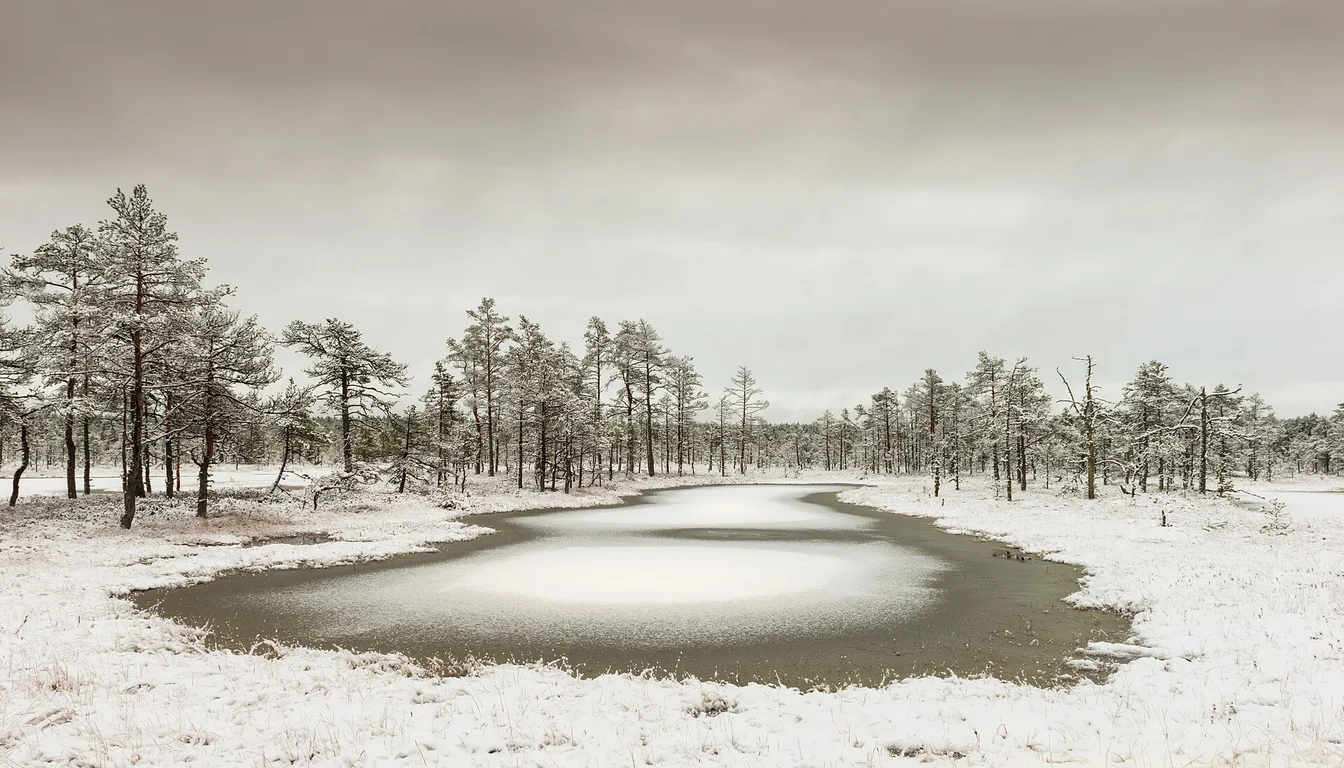
Viru Bog at winter.jpg by Abrget47j, CC BY-SA 3.0. Cropped and resized.
